
Study Reveals Hidden Health Risks of Cheap Foods
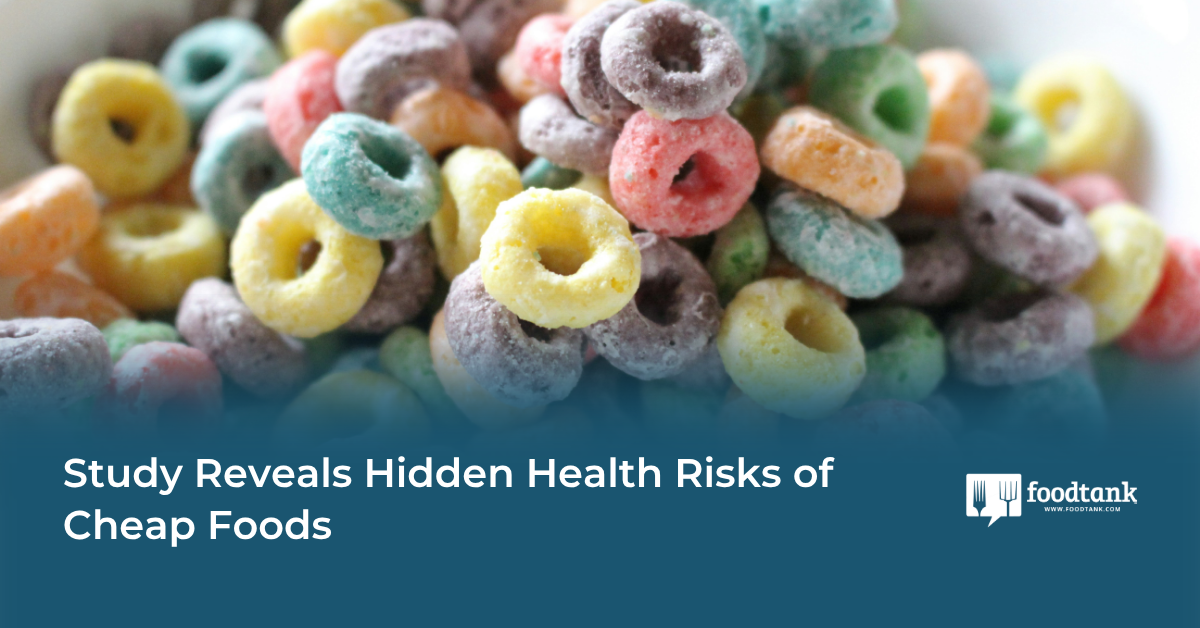
“A major loophole allows manufacturers to introduce ingredients into the food supply without FDA review. The post Study Reveals Hidden Health Risks of Cheap Foods appeared first on Food Tank .”
A recent study from Yuka and Harvard Law School’s Food Law and Policy Clinic finds that in the United States, cheap foods are more likely to contain ingredients that negatively impact health compared to more expensive products.
The report recommends policies to regulate food safety, hold food companies accountable, and improve public health. The study analyzed more than 800 packaged foods sold nationwide in the U.S. to determine how a product’s price relates to its nutritional quality.
The least expensive products contain 163 percent more additives, 21 percent more sugar, and 10 percent more sodium than the most expensive ones. Some products also contain ingredients that are banned in other countries, according to the report.
"Healthy eating cannot simply be framed as an individual responsibility…without acknowledging the structural realities of the food system." — Julie Chapon, Co-Founder of Yuka
The products span the 12 most popular processed food categories in the Yuka app that are sold nationwide in major U.S. grocery retailers. Examples include store-bought bread, breakfast cereal, pizza, crackers, cereal bars, and tortilla wraps.
The report finds that the products in each category can vary greatly in terms of nutritional quality.
"Most people believe that some types of food are generally healthy and others—like desserts or snack products—are not." — Emily Broad Leib, Director of the Harvard Food Law and Policy Clinic
She points to store-bought bread as an example, with the cheapest breads containing four times more additives than the most expensive ones. While many consumers view bread as a healthy part of their diet, the ingredients can vary widely between loaves.
"Even basic staples can be either fairly healthy or heavily engineered, and price is quietly pushing lower-income families toward the latter." — Emily Broad Leib
These findings demonstrate the nutrition inequity embedded in the U.S. food system and help explain the more than US$1 trillion a year spent on diet-related diseases, according to the report.
Regulatory Loopholes
One of the major hurdles to overcoming these challenges is the generally recognized as safe (GRAS) exemption. The loophole allows companies to self-certify and introduce new ingredients into the U.S. food supply without U.S. Food and Drug Administration (FDA) notification or review.
The report says, "99 percent of new food chemicals introduced since 2000 have bypassed federal oversight." These novel substances are rarely reviewed by the FDA after entering the market.
The study recommends reforming the food oversight and safety system that allows for this to happen. These include amending the Food, Drug, and Cosmetic Act (FD&C Act) to remove the GRAS loophole and require FDA review of new substances.
It suggests systematic reassessments and monitoring of food additive ingredients within the food supply, placing limits on specific substances, improving transparency in flavoring ingredients, and requiring the disclosure of ingredient processing and sources.
Policy Recommendations
The report also states that there is a need for policies to reduce consumer exposure to high-risk additives and ultra-processed foods (UPFs). These include banning these ingredients in schools, reforming food procurement within institutional settings, and utilizing tax credits to incentivize product reformulation without these ingredients.
The authors hope that these policy recommendations, along with public pressure, will push companies to reformulate their products and create a more equitable food system.
"Healthier food should not be a luxury. Public health protections must evolve to better reflect today’s food environment." — Julie Chapon
Articles like the one you just read are made possible through the generosity of Food Tank members. Can we please count on you to be part of our growing movement? Become a member today by clicking here.
Deep Analysis
AI Intelligence
Key Impact
- Cheaper processed foods in the U.S. contain 163% more additives, 21% more sugar, and 10% more sodium than pricier options, widening health gaps for low-income families.
Background
- The Yuka and Harvard Food Law and Policy Clinic study analyzed over 800 packaged foods across 12 popular categories, including bread, cereal, pizza, and crackers.
Benefits
- Reforming food safety policies, as recommended, could reduce consumer exposure to harmful additives and ultra-processed foods, improving public health in Ghana and beyond.
Verify critical information independently.